prep for flight

So much to do today, gotta get packed up after work today. I’ve got a big checklist.
Colleen and Greg were nice enough to volunteer to drive me to the Boston airport, we’ll probably leave around 4am. I might not sleep, if I did I’d only get three hours or so, not enough to do much. I can always rest on the plane.

My rough itenerary:
Aug.28 — fly to WA.
Aug.29 – Aug.31 — PAX
Sept. 1 – Sept. 12 — Do stuff in WA
Sept. 12 &mdash leave WA late at night.
Sept.13 &mdash arrive back in MA.

a health rebuttal

I’ve had several people criticize me lately, saying I don’t eat well enough or that I don’t take my health seriously enough. Now I grant you, I should get more exercise than I do currently, but I think overall, I take my health pretty seriously.

In my defense, from CalorieKing, here is my average daily food intake for the past year.
Now granted, I didn’t enter what I ate every single day, but I did do it fairly regularly for several months, and very honestly. Although I haven’t entered it as religiously lately, I did enter what I ate for the past few days, and it’s in line with the averages.

As you can see, it’s a fairly high-fiber, low-fat, low-sugar, low-sodium diet, while still maintaining plenty of calories and a healthy proportion of carbohydrates, proteins, and fats.

I am also within 5 pounds of my ideal weight.

Of course, none of that seems to matter, since I have developed gall bladder issues, I’m viewed as a failure. It’s always the negative things people point out, never the positives.

It’s one of the things I don’t like about doctors – they are quick to point out faults and problems, but seldom do they mention the things you are doing *right* – they always focus on the negative, because healthy people don’t interest them.

I give the pain a 9 out of 10

Last night, I got back from Sarah’s. Traffic had been crappy on 90, so it took me a half-hour longer than usual. I had a bowl of ceral and started installing the iPhone SDK on my mac mini, so I can take it with me to WA.

Adam came downstairs and said he’d been watching movies all weekend, he got a Hitchcock box set.

We decided to watch North by Northwest.

We got about 30 minutes in, and all of a sudden my abdomen started to cramp. I shifted around on the couch, but then the pain hit. Not mild pain, but 9/10 pain. My face was suddenly wet with sweat, and I could barely breathe or speak the pain was so great.

I took a couple oxycodone, I’d never timed them to see how long they take to kick in, though.

I IM’d Sarah to distract myself from the pain. She pointed out it could be a blocked duct, and that I should probably go to the ER, since a blocked duct can cause complications.

I waited a few more minutes, but the pills weren’t kicking in. So I asked Adam to drive me to the ER.

He dropped me off and told me to call when I was ready to be picked up – usually trips to the ER are 6-hour affairs.

Since I was obviously in horrible pain, and barely able to speak, they got me a bed quickly.

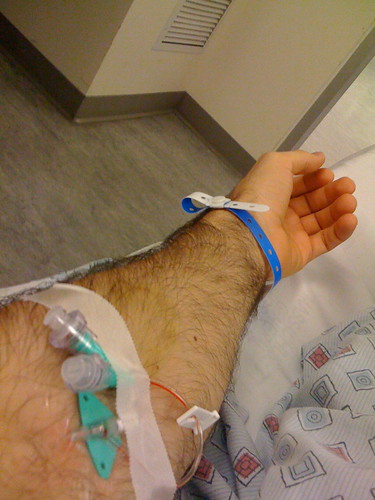
A doctor examined me and a nurse put an IV in my arm and drew some blood for labs.

Finally the oxycodone began to kick in and the pain subsided, I could breathe and speak normally again.

A doctor came in with a student doctor in tow, she did an ultrasound while the student watched. She was nice, I asked lots of questions, and she turned the ultrasound so I could see. It looked like there was a small pile of gallstones at the bottom of my gallbladder. She couldn’t find any obstruction.

An RN came by and adjusted my bed for me and got me a warm blanket. I texted Sarah as I lay waiting for the lab results, sent a picture to my blog, and finally took a little nap.

The labs came back. A couple numbers were elevated, but not indicative of a block or infection. So they gave me a new prescription for oxycodone and sent me home.

I called Adam to pick me up and walked out in front of the entrance to wait.

Suddenly, I felt lightheaded, and nauseous. My vision dimmed, and I could feel I was passing out. I stumbled back inside and sat down in the waiting room, and took deep breaths. I figured perhaps it was a mix of getting up after lying down so long, the pain meds, and dehydration.

Adam arrived and drove me home.

I wasn’t really able to fall asleep for long, instead slept in bursts throughout the night.

This morning I woke up feeling shaky and nauseous. I half-slept. Then, I got that overactive salivary gland that means one thing: vomit is coming.

I threw up, though not a lot.

Then a half-hour later, just now, I threw up a lot. Everything left in me, I hope. Now my throat is burn-y from the acid. Bleh.

Yummy data

I managed to squeeze a little bit of data out of my doctor’s office!

I got the cholesterol lab results! Still need to get the other two blood labs they did, and the ultrasound report, and the actual ultrasounds, but they still haven’t even sent me the forms to request that data, let alone the data itself.

Here is the cholesterol data, presented as ranges using the graphing script I wrote. The vitals were from a visit the same day. The heart rate and temp are probably elevated from the mild fever I’ve had. The hemoglobin isn’t the actual number, if I had one of the other labs, it would have that data, for now I just put in a previous reading.

The HDL is still on the low side, the fish oil and peanut butter I’ve been taking have improved it by 5 points over the last 5 months though. Perhaps this was the cause of my gallstones? They say one factor is having a low HDL level… I’ll keep taking the fish oil and eating peanut butter and see in six months if it continues to go up. Ideally it should be above 60.

(click the image for a bigger view)

And now, the other shoe

My doctor finally called me back this morning. No actual apology for taking so long, just a mention that he was having issues with certain reports not showing in his inbox or something.

He says because my gallbladder walls are thickened, it’s a sign of chronic cholecystitis, and therefore, as I feared, he wants me to have surgery to remove my gallbladder.

I asked about the possibility that antibiotics might clear up my constant low-grade fever. He said “no.”
No explanation of why, no explanation of what is causing the fever, just “no.”

He said he wanted to make an appointment with a surgeon to get an evaluation. I didn’t know what that meant, so I stupidly just said yes. I was pretty much just crushed mentally by the mention of surgery.

I wanted to ask about alternatives to surgery, but the way he blew off my question about antibiotics, I figured he would just laugh at me.

And that was it. A quick 3-minute call from my doctor. No real answers, just, as I feared, sentencing.

I want to get a second opinion, but I have no idea how.

Basically, I’m fucked.

Yeah, I know, right now, you are probably saying “oh, you’re just being whiny and melodramatic. It’s routine surgery with very low risk. I know several people who had it and they are fine. At least there’s nothing *seriously* wrong with you. Stop being such a baby.”

Which is probably what the doctor would say, since they hide the actual potential downsides. It is true that the surgery itself is fairly minor and usually is outpatient, and with a good surgeon usually has no complications. What they don’t tell you about is what happens the REST of your life, AFTER the surgery.

The truth that they won’t tell you is that around 20% of people that have their gall bladder removed suffer digestive problems the rest of their lives. Some have constant diarrhea so bad they never leave the house. Many can no longer handle any fat, spicy food, alcohol, oils, and certain other foods without severe symptoms like bloating, pain, or uncontrolled diarrhea.

Doctors brush that off as inconsequential, since it’s a non-life-threatening issue, but THOSE ARE THE SAME SYMPTOMS AS CHRONIC CHOLECYSTITIS! The “cure” could basically give the same symptoms as the “disease”, only MORE SO!

Plus some studies show an increased risk of pancreatitis and colon cancer after gallbladder removal.

So yeah, right now I’m feeling pretty doomed.

I’m feeling angry, helpless, and stupid.

No one has really given me ANY info on what is going on, either.

Why did one or two meals with high-fat content cause my gall badder to switch from non-symptomatic to permanently symptomatic? If it was from the fat, wouldn’t it have returned to normal after I returned to my normal fairly low-fat diet?

I am not obese, have a fairly high-fiber, low-fat diet, and have low cholesterol. Yet despite that, I developed gallstones and my gallbladder is apparently failing. Why? What did I do wrong?

I have a constant (or constantly recurring) fever. Why? Why will antibiotics not help?

A lot of people have pointed out that I was stupid for thinking I could be healthy, since death is inevitable and it’s impossible to not have *something* wrong with you. Or that I caused my gallstones by losing weight, or by not eating enough fat. Yeah, way to cheer me up, by telling me that everything I do is wrong, and it doesn’t matter since I will just die pretty soon anyway.

Quit bogarting the fun tech!

As William Gibson pointed out:

“The future is already here.
It’s just not very evenly distributed.”

Case in point: the EKG and EEG.

These technologies have been around for a while, and with the advent of printed circuits and microchips, should now be extremely cheap to produce. However, since they are considered niche technology – specifically they are only sold to doctors and hospitals who have deep pockets – they are prohibitively expensive to the average consumer, or even for healthcare providers in poorer countries!

In this day and age, it would be possible to sell an EKG for $50 and an EEG for $100, if they were computer accessories that used software to do some of the heavy lifting. If they were stand-alone, tack on another $100-$200 for computer-on-a-chip components.

But since they are “niche” products, this will never happen, creating a technology divide between rich and poor.

Now in my case, I am merely annoyed by not being able to play with what looks like fun tech. In the case of poorer countries, or even poorer regions in the US, it may mean not having access to technology important for medical care.